Breast Augmentation
Breast augmentation enhances breast size and shape using implants or fat transfer, with a customised surgical plan based on body frame and goals.
Also known as: Breast implants, Augmentation mammoplasty
Am I a candidate?
- Women seeking increased breast volume or improved symmetry
- Post-pregnancy or post-weight-loss volume loss
- Healthy, at a stable weight, with no active breast disease
The procedure
- General anaesthesia in an accredited facility
- Incision placed inframammary (under breast fold), periareolar, or transaxillary
- Pocket created subglandular or submuscular; implant inserted (silicone or saline)
- Closure in layers; comprehensive pre-operative planning with sizing
Recovery
- Surgical bra worn for 4–6 weeks
- No arms overhead for approximately 2 weeks
- Return to work within approximately 1 week
- Implants settle over 3–6 months
Risks & considerations
Risks include capsular contracture, implant rupture, infection, rippling, asymmetry, change in nipple sensation, and the rare condition of breast implant-associated anaplastic large cell lymphoma (BIA-ALCL). Further surgery may be required over time.
Medicare & rebates
Breast augmentation is a cosmetic procedure and a Medicare rebate does not apply.
Medicare item numbers and eligibility criteria are set by the Australian Government and can change or be revised over time. Your current eligibility is confirmed at your consultation.
Clinical photographs
Educational onlyFor privacy, photographs are blurred by default. Click to view; click again to move through the angles.
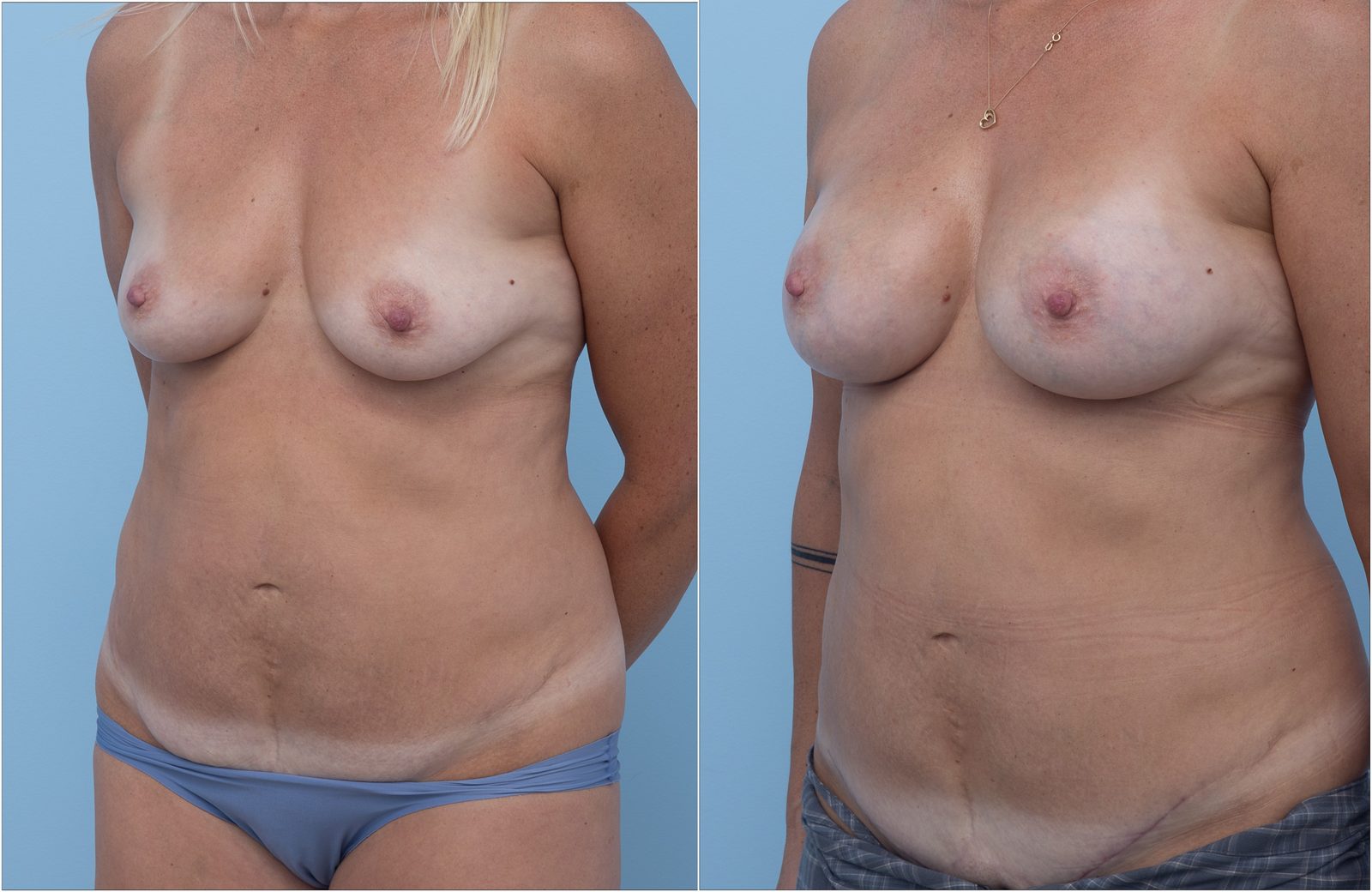
These photographs are published for general educational purposes only and do not constitute medical advice or a guarantee of any particular outcome. Unless otherwise stated, images are taken approximately 3 months after surgery; at this stage scars can still look red and darker, which varies with skin type. Over time they typically settle into a fine line that is usually paler than the surrounding skin, and the final shape settles with time — the timing and final appearance vary with skin type and ethnicity. Every patient is different and individual results vary. All surgery carries risks, and you should seek a second opinion from an appropriately qualified health practitioner. Images are published with the patient’s written consent and have not been altered to misrepresent results. A consultation with Dr Livingston is required to determine your suitability for any procedure. Dr Ryan Livingston is an AHPRA-registered Specialist Plastic Surgeon (MED0001523680).
Frequently asked questions
What implant types are available?
Silicone or saline implants in various shapes and profiles, discussed during consultation.
Does Medicare cover breast augmentation?
No — this is a cosmetic-only procedure and no rebate applies.
How long do implants last?
Implants are not lifetime devices and may need replacement over the years. Ongoing monitoring is recommended.
This information is general in nature and does not constitute medical advice. Any surgical or invasive procedure carries risks; you should seek a second opinion from an appropriately qualified health practitioner. Individual results vary. A consultation with Dr Livingston is required to determine your suitability for any procedure. Dr Ryan Livingston is an AHPRA-registered Specialist Plastic Surgeon (MED0001523680).