Ear Surgery (Otoplasty)
Ear reshaping surgery to correct prominent or asymmetric ears, improving natural proportion and balance.
Also known as: Otoplasty, Ear pinning, Ear reshaping
Am I a candidate?
- Children over 5 years of age with prominent or protruding ears
- Adults dissatisfied with ear projection or shape
- Healthy patients without bleeding disorders
The procedure
- General anaesthesia for children; local anaesthesia with sedation for adults
- Incision placed behind the ear
- Cartilage scored and sutured to reshape; skin redraped
- Closure and protective dressing applied
Recovery
- Headband worn for 2–6 weeks, particularly at night
- Swelling reduces in 1–2 weeks
- Contact sports avoided for 6 weeks
- Final shape at 3–6 months
Risks & considerations
Risks include infection, haematoma, cartilage exposure, asymmetry, suture reaction, over- or under-correction, and scarring. Contact sports post-operatively may risk recurrence.
Medicare & rebates
A rebate may apply for congenital ear deformity. Purely cosmetic cases are not covered. Eligibility is assessed at consultation.
Medicare item numbers and eligibility criteria are set by the Australian Government and can change or be revised over time. Your current eligibility is confirmed at your consultation.
Clinical photographs
Educational onlyFor privacy, photographs are blurred by default. Click to view; click again to move through the angles.
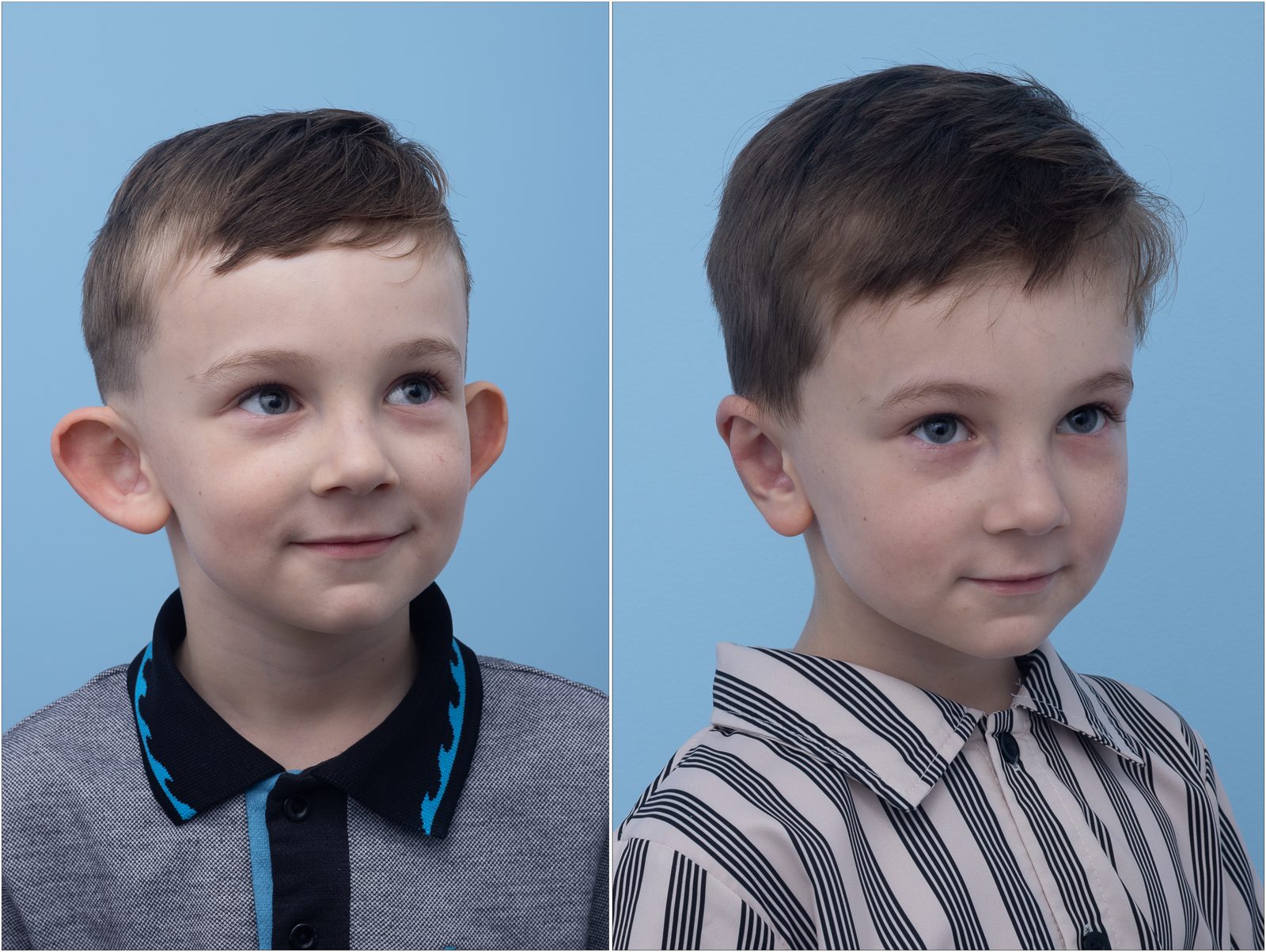
These photographs are published for general educational purposes only and do not constitute medical advice or a guarantee of any particular outcome. Unless otherwise stated, images are taken approximately 3 months after surgery; at this stage scars can still look red and darker, which varies with skin type. Over time they typically settle into a fine line that is usually paler than the surrounding skin, and the final shape settles with time — the timing and final appearance vary with skin type and ethnicity. Every patient is different and individual results vary. All surgery carries risks, and you should seek a second opinion from an appropriately qualified health practitioner. Images are published with the patient’s written consent and have not been altered to misrepresent results. A consultation with Dr Livingston is required to determine your suitability for any procedure. Dr Ryan Livingston is an AHPRA-registered Specialist Plastic Surgeon (MED0001523680).
Frequently asked questions
What is the minimum age for otoplasty?
Ear growth is typically complete around age 5, making surgery suitable from that age.
Are both ears treated?
Often both, to achieve symmetry, though single-ear correction is possible.
Does Medicare cover otoplasty?
Possible for congenital ear deformity; eligibility is assessed during consultation.
This information is general in nature and does not constitute medical advice. Any surgical or invasive procedure carries risks; you should seek a second opinion from an appropriately qualified health practitioner. Individual results vary. A consultation with Dr Livingston is required to determine your suitability for any procedure. Dr Ryan Livingston is an AHPRA-registered Specialist Plastic Surgeon (MED0001523680).